Contaminants
PFAS in New Castle County water: what the numbers actually mean
PFAS is the contaminant we get the most questions about in New Castle County — and the one where the marketing noise is loudest. Here is how to read your own numbers.
If you live in New Castle County, you have probably seen a headline about PFAS — the "forever chemicals" that show up in groundwater near industrial sites, firefighting-foam training areas and older manufacturing corridors. Delaware is one of the more heavily documented PFAS regions in the country, so the concern is real. But a headline is not a test result, and the right response depends entirely on your own water.
What PFAS actually is
PFAS stands for per- and polyfluoroalkyl substances, a family of thousands of synthetic chemicals used since the mid-20th century in nonstick coatings, water-repellent fabric, food packaging and firefighting foam. They are called "forever chemicals" because the carbon-fluorine bond that makes them useful also makes them extremely slow to break down in the environment and in the human body.
The two names you will see most on a lab report are PFOA and PFOS. In 2024 the EPA finalized the first federal drinking-water limits for these compounds, measured in parts per trillion — a unit small enough that it helps to picture a single drop in a very large swimming pool.
Where New Castle County water comes from
Most homes here are on public water: Artesian Water across the suburbs, Veolia Delaware in the Brandywine Hundred area, and the City of Wilmington drawing surface water from the Brandywine Creek. Public utilities test and treat for regulated contaminants and publish an annual water-quality report. Private wells, more common south of the canal, are not covered by those utility programs — if you are on a well, no one is testing your water but you.
How to read a PFAS result
- Look for individual compounds (PFOA, PFOS) and any combined "hazard index" figure, all reported in parts per trillion (ppt) or nanograms per liter (ng/L) — they are the same unit.
- Compare each number to the current EPA limit rather than to zero. Detection does not automatically mean exceedance.
- Note the collection date and where the sample was taken — at the plant, in the distribution system, or at a home tap. Only a tap sample reflects what you actually drink.
- If you are on a well, a "non-detect" from a neighbor is not your result. Groundwater plumes are patchy.
What actually removes PFAS
The good news is that PFAS is one of the more treatable contaminants at the point of use. Two technologies have the strongest track record: high-quality activated carbon and reverse osmosis. For drinking and cooking water specifically, a reverse osmosis system under the sink is the most reliable, certification-backed option for most homes. Whole-house carbon can reduce PFAS across every tap but needs to be sized and maintained correctly to keep performing.
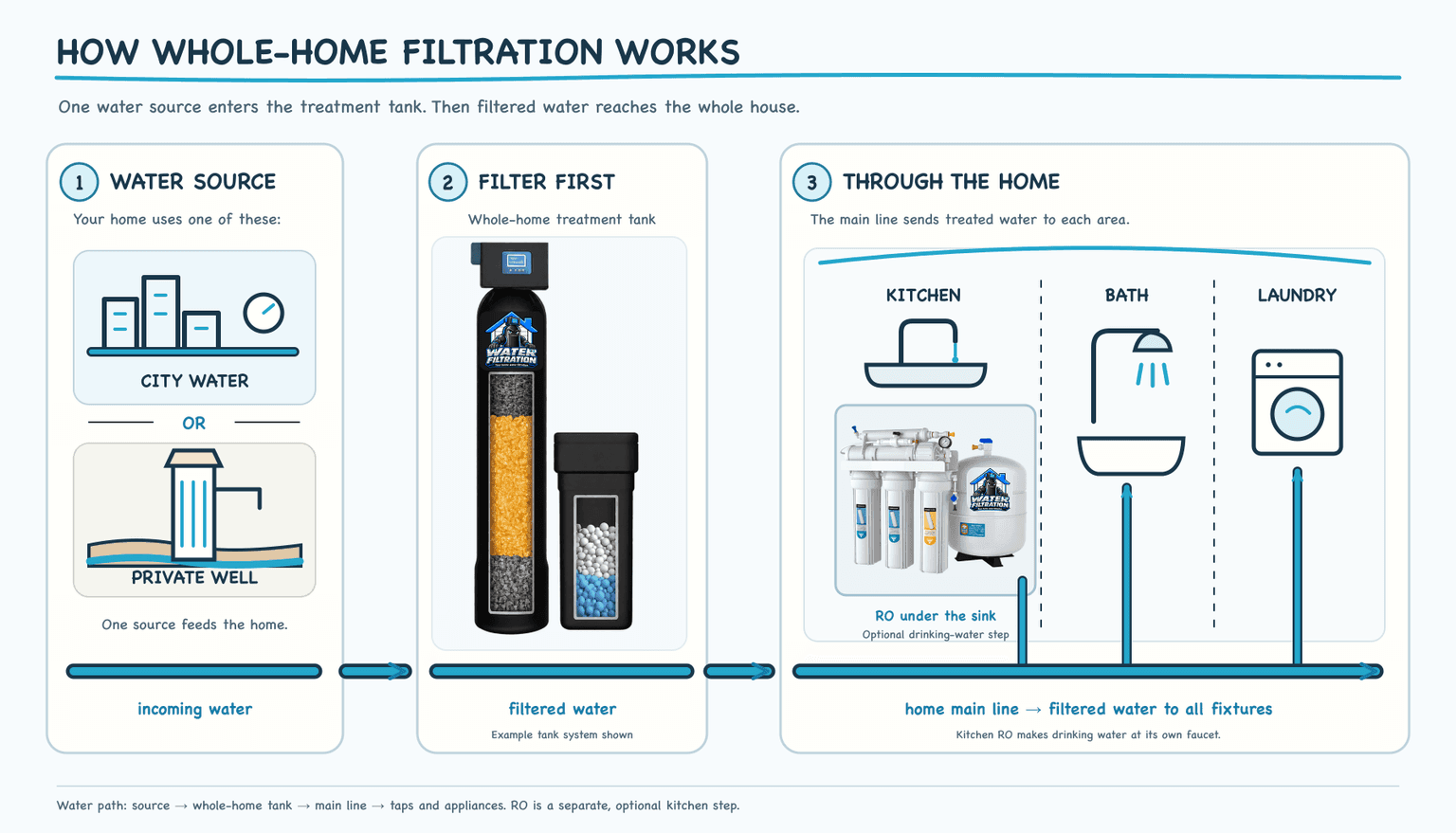
What matters more than the brand is the sizing and the proof: a system chosen for your measured PFAS level and independently certified for PFAS reduction, not a generic "filters everything" claim. That is exactly why we start every job with a free test instead of a sales pitch.